
Comparison Guide
PAB vs. BrickLink: Sourcing Guide
The PAB versus BrickLink decision is rarely about headline price alone. Mosaic builders are also choosing between convenience, color stability, stock risk, shipping behavior, and how much time they want to spend optimizing orders. The right route depends on the project and the builder. A portrait gift with a deadline has very different priorities from a slow custom build where sourcing rare shades is part of the fun.
Direct answer: Use Pick a Brick when you want a simpler, more predictable base order built around currently available official stock. Use BrickLink when you need rare colors, partial top-ups, or flexible seller combinations. In many real projects the best route is hybrid: use PAB for the stable bulk of the order, then use BrickLink for exceptions the official catalog does not cover well.
Best for: This guide is for builders comparing sourcing routes for portraits, gifts, and wall-art mosaics where cost and availability can materially change the final project.
Avoid: If you already know you will source only from existing personal inventory or from a single preferred seller, this article may be more strategic than necessary.
Recommended setup: Start with the cleanest version of the image, estimate the true piece count, then choose the sourcing route that best matches the timeline and palette. For most builders, PAB is the simpler foundation and BrickLink is the precision tool.
Who This Guide Helps
This guide is for builders comparing sourcing routes for portraits, gifts, and wall-art mosaics where cost and availability can materially change the final project.
Who Should Skip It
If you already know you will source only from existing personal inventory or from a single preferred seller, this article may be more strategic than necessary.
Bottom Line
Start with the cleanest version of the image, estimate the true piece count, then choose the sourcing route that best matches the timeline and palette. For most builders, PAB is the simpler foundation and BrickLink is the precision tool.
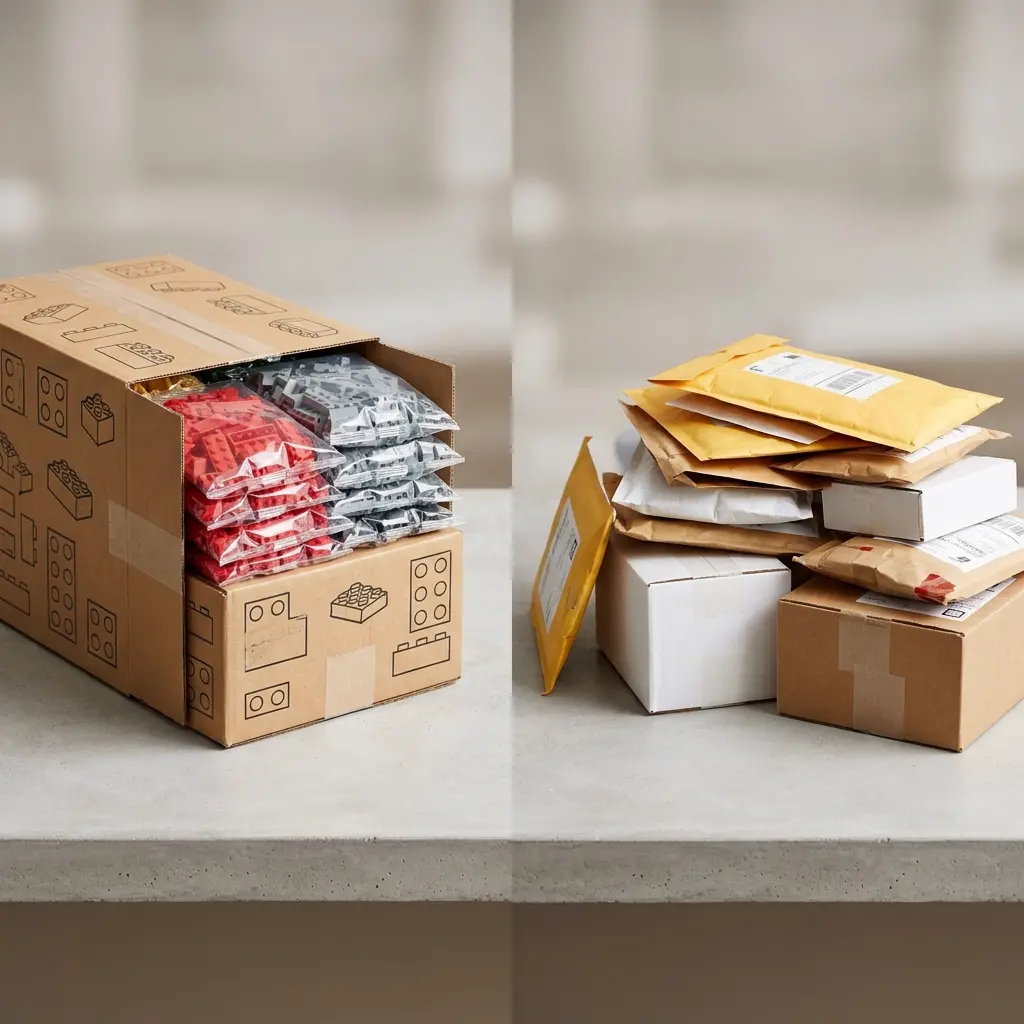
The sourcing dimensions that actually decide the route
The better route depends on more than sticker price. These are the dimensions that affect real mosaic projects most.
Price stability
PAB is often easier to budget because pricing and fulfillment are centralized. BrickLink can be cheaper or more expensive depending on color, quantity, seller mix, and shipping combinations.
Shipping and order simplicity
One official order can be worth a lot if you want fewer moving parts. BrickLink offers flexibility, but that flexibility can become labor when the order splits across many sellers.
Color availability and rare shades
BrickLink becomes powerful when the exact palette needs colors that official current stock does not support cleanly. That matters on nuanced portrait work and on builders trying to match existing inventory.
Restock and replacement risk
If you might need to reorder missing or damaged parts later, predictability matters. Stable routes are easier to recover from than one-off bargains that vanish.
Procurement matrix for mosaic builders
This matrix is the fastest way to compare what each route is actually buying you.
| Dimension | Pick a Brick | BrickLink | Best fit |
|---|---|---|---|
| Price volatility | Usually more stable | Can vary by seller and lot | PAB for predictable budgeting |
| Shipping speed | Centralized but can vary | Depends on seller location | BrickLink for local fast fills, PAB for simple planning |
| Color stability | Strong for current catalog colors | Strong for rare or discontinued hunts | Depends on your palette |
| Out-of-stock risk | Tied to official inventory windows | Tied to seller stock and fragmentation | Hybrid order for risk control |
| Mixed-order complexity | Low | High when split across sellers | PAB for bulk, BrickLink for edge cases |
Sourcing mistakes that create avoidable cost
Builders often treat the route decision as a shopping exercise when it is really a project-structure decision.
Comparing sellers before fixing the crop and palette
If the image still contains avoidable background or unstable color choices, you are trying to optimize the wrong order instead of the right one.
Choosing BrickLink only because it feels more expert
BrickLink is powerful, but it is not automatically the better route. Sometimes the simpler official path is exactly what keeps a build practical.
Ignoring mixed-order overhead
Ten small shipping charges and ten different arrival times can erase the benefit of a seemingly cheaper order, especially on deadline-sensitive gifts.
Forgetting replacement logic
If a project needs just a few more parts later, the best route is not merely the cheapest first order. It is the route that is least painful to revisit.
When Pick a Brick is usually the right answer
PAB is strongest when you have a current-color project, want a simpler checkout experience, and value predictability over hunting. Portraits with cleaner crops and mainstream tones often fit this route well because the bulk of the build can be covered by stable official stock without the friction of managing many small sellers.
That simplicity has value. It reduces the chance that sourcing becomes the most stressful part of the project. For beginners, that is often worth more than a theoretical savings that requires much more order management.
When BrickLink earns the extra complexity
BrickLink shines when the palette is specialized, when local sellers can solve shipping urgency, or when the project needs shades that are awkward to source officially. It also helps when you are topping up an existing stash and only need precise missing pieces instead of a full fresh order.
The risk is that the route can become fragmented quickly. That is why BrickLink works best when used intentionally. If you know the exact reason you need it, the complexity is usually justified. If you are only using it because it sounds more advanced, it may be the wrong tool.
Why a hybrid order is often the smartest route
Many of the strongest mosaic sourcing plans are hybrid. Use PAB for the stable bulk colors, then use BrickLink for narrow corrections, rare shades, or local urgency. That structure captures the strengths of both routes without forcing either one to solve every problem.
This approach becomes even more powerful when paired with a cleaner image. A subject-first crop and disciplined palette reduce the number of exceptions, which makes the hybrid route easier to manage and often cheaper in practice.
Example: a 64×64 portrait using 4,096 pieces with 18 colors. 15 colors are available on Webrick ($0.03/pc). 3 rare colors need BrickLink (~200 pieces at $0.05/pc average). Total: ~3,896 × $0.03 + 200 × $0.05 = $117 + $10 + ~$8 shipping = $135. Compare to $246 all-PAB.
How to turn this comparison into a real decision
The fastest way to misuse a comparison guide is to treat it like a ranking chart and ignore the context of the actual project. The better approach is to decide what matters most for this specific build first, then let the comparison answer that narrower question. Start with the cleanest version of the image, estimate the true piece count, then choose the sourcing route that best matches the timeline and palette. For most builders, PAB is the simpler foundation and BrickLink is the precision tool. If the project has a deadline, practical simplicity usually matters more than theoretical perfection. If the project is open-ended and highly personal, precision may deserve more weight than convenience.
A smart next step is to run one realistic test image all the way through the decision lens described above. Do not compare abstract possibilities forever. Compare one image, one crop, one likely room or gifting context, and one honest budget. That is where the trade-off becomes concrete. Once the decision is tied to a real image instead of a hypothetical one, the "best" option usually becomes much clearer.
- Define what you care about most before comparing the options: realism, ease, cost control, or room feel.
- Test one real image or project instead of debating the category in the abstract.
- Choose the option that reduces the biggest risk for this build, not the option that wins the most categories on paper.
If you want to pressure-test that choice from another angle, read BrickLink vs PAB vs Webrick and How Many Pieces?. Those follow-up guides usually reveal whether the current decision still holds once source image, palette, or room context becomes more specific.
How BMBrick makes sourcing decisions easier to trust
BMBrick matters here because it lets you judge the build plan before you start chasing sellers. If the crop, palette, and count are still unstable, no sourcing optimization will feel fully satisfying. The cleaner the project definition, the cleaner the route decision.
Once the plan is stable, BMBrick can export route files such as PAB CSV, Webrick CSV, and BrickLink XML so the sourcing comparison turns into concrete order inputs instead of a manual shopping guess.
Use this guide alongside How Many Pieces? and the color guide. Together they answer the three route questions that matter most: how much you need, which colors are essential, and how much complexity the project actually deserves.
FAQ
Which route is usually cheaper?
It depends on the palette and the seller mix. PAB often wins on simplicity and stable budgeting, while BrickLink can win when the project needs specific rare or local inventory.
Which route is better for beginners?
Usually PAB, because the simplicity and centralized flow reduce the chance that sourcing becomes overwhelming.
When should I use both?
Use both when the base order is easy to handle officially but a few colors or top-up needs make BrickLink valuable.
Can better image planning reduce sourcing pain?
Absolutely. Cleaner crops and calmer palettes often reduce the number of tricky parts you need to chase in the first place.
Where To Go Next
Next reads: