How to solve a Zip-style path puzzle.
A single line, numbered checkpoints, and a grid that must be completely filled. The rules are simple; the trick is making sure your next move won't trap an empty square later.
Quick answer: how do you solve a Zip-style puzzle?
Start at 1. Move one square at a time horizontally or vertically, passing numbered checkpoints in ascending order. Do not cross a wall or reuse a square. Cover every square exactly once and enter the highest numbered checkpoint on your final move. To avoid getting stuck, inspect forced corners and narrow corridors first, and keep remaining empty cells connected.
The interactive example below demonstrates these rules with an original Pathgrid 5×5 board and one-step hints. For unlimited practice, open the practice game.
The three rules
Start at 1 and move only horizontally or vertically, one cell at a time. Never move diagonally.
Visit every numbered checkpoint in ascending order. Thick walls between cells block the path.
Fill every cell exactly once before you reach the final number. You can't cross the line or visit the same square twice.
These are the same general path-filling mechanics used by LinkedIn's Zip. This page demonstrates them with an original Pathgrid board, not a copy of any official puzzle.
Try a real 5×5 puzzle
Drag or tap across the squares. Use Show next correct step to see the next move along the valid route. You can use it repeatedly to walk through the whole answer, then Reset and solve by yourself.
One solution has been verified for this specific example. Practice another board at 5×5, 6×6 or 7×7 once you're ready.
Worked example
5 × 5 · 25 cellsStart at checkpoint 1.
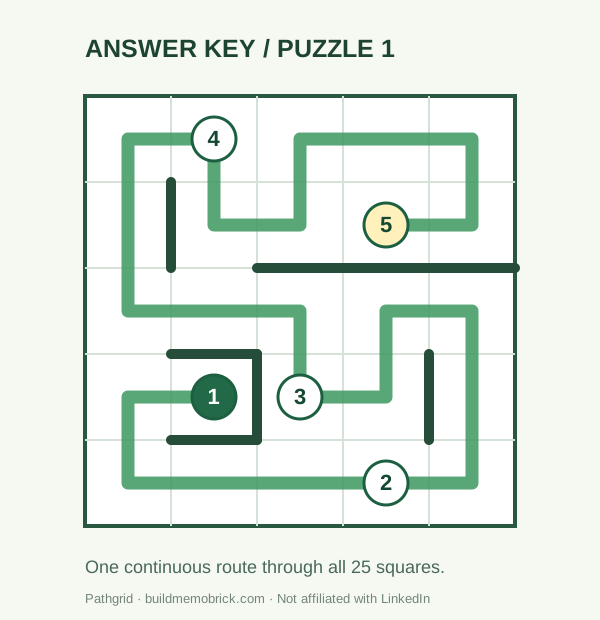
Same original puzzle every visit · Seed 104921
Zip puzzle strategy: reason before you draw
1. Check corners first
A normal corner has only two neighboring cells. Unless it contains the start or final number, a complete path must pass through both open sides. Marking these forced links mentally can reveal a longer corridor.
2. Count the open sides of a square
Walls can turn an ordinary edge or interior cell into a forced passage. Every cell except the two endpoints needs one entry and one exit. If only two neighboring edges are available, both are necessary.
3. Don't close off an empty region
Before a long detour, look ahead: will the path split the remaining empty cells into disconnected groups? You only have one continuous route. If you isolate unused squares, the detour cannot be right.
4. Treat the final number as your last move
The highest numbered cell is not a checkpoint you may pass through early. Plan how you'll enter it after covering the rest of the grid; this often determines the direction of the last few moves.
5. Work from numbered stops in both directions
Even though your drawn path starts at 1, it helps to reason backward from the last stop. Identify narrow sections that must connect two numbered squares, and leave enough open space for later sections.
6. Use a hint to learn a decision, not to skip it
When you're unsure, identify your next two possible moves and why one might fail. Then reveal one step, compare it with your prediction, and reset the board to practice that idea without hints.
Common mistakes
Skipping a square: reaching the last number does not win unless the entire board is filled.
Crossing a wall: bold borders between cells are blocked, even if a shortcut looks tempting.
Entering the last checkpoint too soon: save it for the very final step.
Revisiting a square: a single-path puzzle cannot have loops, branches, or crossings.
Practice or print these rules
Want to work through new problems? Our original game generates a new board on demand with a validated solution.
The sample PDF has eight playable number-path puzzles plus matching solution pages.
Frequently asked questions
Does Zip always have one solution?
A well-constructed puzzle should have a unique path. Pathgrid checks that the generated board is constrained to one solution before presenting it.
Does moving diagonally count?
No. Paths move up, down, left or right through neighboring cells. A diagonal jump isn't a legal step.
Is Pathgrid the official LinkedIn Zip guide?
No. It is an independent tutorial for a similar number-path puzzle mechanic. Pathgrid is not affiliated with or endorsed by LinkedIn.
Can I solve a Zip-style puzzle without signing in?
Yes. Play the original worked example above, or generate unlimited independent Pathgrid boards on the practice page, entirely in your browser.